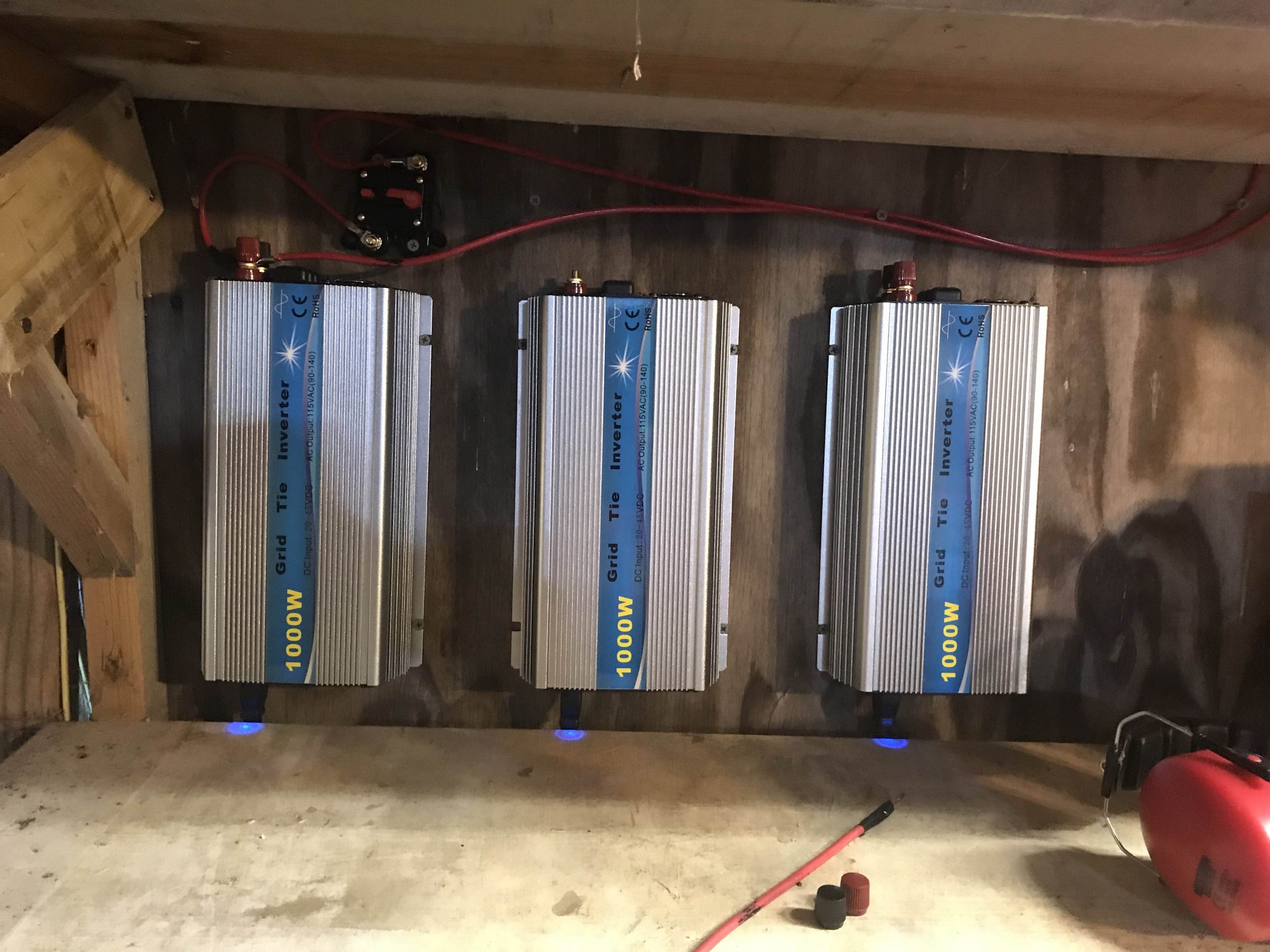
DIY Install of the Grid-Tie Solar Systems
A Grid tie solar system produces power while your house is still connected to street power. This can be more convenient than “Off-Grid” solar. With Grid-Tie solar, you are able to produce what solar power you can from your solar system and any additional power that you need will come from the “Grid” or “Street Power”. Any power you produce that is greater that the power you are consuming will go out to the grid which can further help reduce you power bill. Grid-tie systems usually do not use batteries as excess power is pushed out to the grid.
However, there can be a good deal of regulatory hurdles with dealing with the power company. Because a Grid-Tie solar system is able to push power onto the grid, your power company will want to make sure the solar is installed correctly. You will need to check with your power company to make sure you are allowed to grid-tie.
One additional drawback of grid-tie systems is that if the grid (street power) goes down, the grid-tie solar equipment disables itself to prevent pushing power onto the grid which can kill linemen that are working on the power lines. This means that if the grid is down, you will not have any power, even from your solar.
See installation notes at the bottom of the page for things to watch for during your install.
https://tennesseevalleysolar.com/what-not-to-do/
We have created a special learning section for our site that contains a lot of articles, videos, and more information in relation to all things solar.
For even more information about solar configuration, Click Here to Read More.
Plug-and-Play” Grid-Tie Solar
This type of grid tie is the easiest to setup. The installation usually follows these steps:
- Setup solar panel array
- Mount Equipment
- Connect solar power positive and negative to the grid-tie
- Plug the grid tie into the wall and turn it on
- Profit!
See the “Plug-and-Play” Video below for more Information.
Tips and Installation Notes
This inverter is designed and sold for a DIY installation. Because of this, it is up to you to fully understand the ins and outs of this equipment. Read and fully understand the manual before starting. Incorrect installation WILL cause problems. Make sure you change the settings on the inverter to be right for your installation. You will need a working Multimeter and you will need to know how to use it.
Damage caused by incorrect or poor installation will be your responsibility. Please remember that just because it doesn’t work the way that you think it should does not mean that I sold you junk. This equipment is complicated and can be confusing to install. We have had customers who have had issues with their installs and jumped to assuming that the issues were caused by a defective unit which had been damaged by the customer.
- The SPF 5000 ES and the Transformer each connect to their own double pole 50 Amp breaker (Photo 8)
- You should have a breaker between your panels and the inverter. (Blue/White box on left side of Photo 2) Also, have a breaker between the Inverter and your batteries.
- The transformer is wired to the breaker box with L1 and L2 on the transformer going to the double pole breaker. Then I have the neutral and the ground wired to the ground bar. Separate these if you have separate ground and neutral bars. (Photo 6)
- For the AC input and output you will need to wire the connections labeled ‘L’ and ‘N’ to your double pole breaker. On the inverter, they should be labeled as L1/L2 as both the ‘L’ and ‘N’ connect directly to the double pole breaker. (Photo 4)
- If you are going to have another SPF 5000 ES Unit wired in “Parallel”, it will need to be connected to it own (separate) double pole 50 amp breaker. You will need to make sure that the second unit is wired EXACTLY THE SAME WAY as the first unit. If you have ‘L’ on the inverter going to the top pole of the breaker on the first unit, then do the same thing on the second unit. Do not cross wire the units!
- Changing the settings is one of the most important steps to installing this inverter. After getting your SPF 5000 ES setup, you MUST go into the settings program on the LCD screen and change the unit to use 60 Hz in program 09 (Bottom right of Photo 11). Other Settings we suggest to use when setting up for off-grid use are in Photo 12.
- Please note, the settings above are for Flooded Lead Acid Deep Cycle Batteries. If you are using Lithium Batteries with a BMS connection (Network cable from battery to inverter), you would want to set Program 05 to “LI” and Program 36 to “L01”.
- I would suggest going through the setting section of the manual and marking what settings you need to change. (Photo 11)
- Your solar panel string voltage needs to be greater than 120V DC. If you have 30 volt panels, I suggest having at least 5 of them in series which would have your string voltage at 150V. The voltage of the panels can drop when the panels are under load so I would suggest using 5 of them.
- You should bring your strings in and combine them in a combiner box or bus bars. This puts the strings in Parallel with each other. (Top left of Photo 2)
- For the SPF 5000 your batteries MUST be in a 48 volt configuration. For a lot of people, this means putting 4 12V deep cycle batteries in “series”. This would mean connecting the batteries end to end positive to negative in a long string. The inverter can also work with 48 volt Lithium battery packs such as ones sold by Rocket City Solar. However, the Inverter can also be used with out any batteries at all, which would only give you solar power but no battery power.
- This inverter has an AC input that can be used to power your house and charge your batteries. You can connect this input to “Street/Grid” power or you can connect the input to a generator. We have been warned that generators can make VERY “dirty” power that can damage the inverter. If you are looking to use a generator on the input, you may want to look into some kind of line filter or something to clean the power. Or you can hook your generator up to separate 48v battery chargers which will help to protect the inverter from power spikes coming from the generator.